Producing substrate for mushroom cultivation has specific and important requirements. It sounds simple to say that mixing the compost is important, but the question is: why is this so, and what exactly is meant by mixing compost? This often turns out to be a point of discussion with course participants.
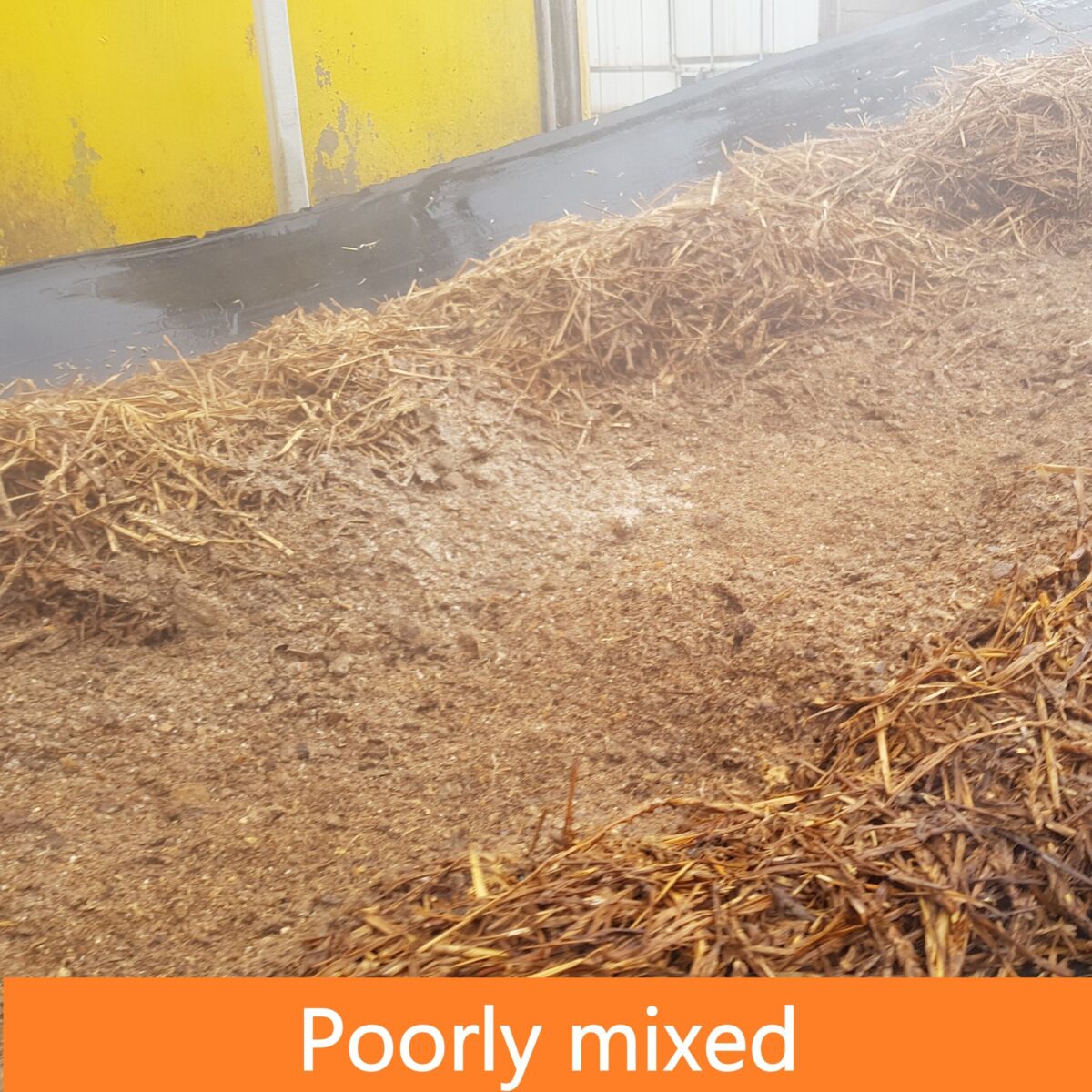
At first glance, mixing substrate does not seem that complicated. You scoop it up with the loader, add the chicken manure, throw it over the straw, and then scoop the mixture into the hopper and let it fall somewhere, for example into a bunker. In that sense, you have mixed it. But when producing substrate, it’s not about mixing “a little”. It has to be mixed completely, i.e. 100% homogeneously. Only then will you create a substrate with uniform quality and optimal conditions for the further composting process.
Every blade of straw must contain the same amount of chicken manure. This is where micro-mixing comes in. The straw has been treated with water for several days beforehand, which removes the wax coating. This makes the straw sticky, allowing the chicken manure to adhere to it. However, this adhesion only occurs in the places where the straw actually comes into contact with the chicken manure. Where no chicken manure touches the straw, nothing will stick. That is why it is essential that the mixing is done so effectively that every single blade of straw comes into contact with chicken manure. Only then can you achieve the desired micro-mixing level.
If the mixing is not done properly, areas will develop in the substrate where there is too much chicken manure, sometimes even in the form of clumps. In these areas, the micro-organisms need much more time during phase 2 of the composting process to break down the ammonia. The result may be that the compost does not become ammonia-free at all, even though this is a prerequisite for the mycelium to grow properly. Even if the ammonia is eventually removed, the process will take considerably longer if the chicken manure is poorly distributed. This delayed process has several disadvantages:
Poor mixing therefore has a direct and negative impact on both the composting process and the final cultivation result.
In practice, I often leave the exact method to the customer, because every installation and every raw material flow can be different. However, there are a number of important principles that contribute to good micro-mixing. Firstly, it is wise to mix the chicken manure with gypsum beforehand. This makes the manure less greasy and allows it to be distributed more easily and evenly over the straw. In addition, it is essential that clumps in the chicken manure are ground, for example with a hammer mill, before the mixture is added to the straw. This prevents large concentrations of manure and promotes even distribution.
The flow of straw and chicken manure during mixing must also be even, so that each straw particle has sufficient contact with the manure. Some customers use alternative methods. For example, I have a customer who first mixes the chicken manure with water to remove lumps. It is crucial that mixing continues until the entire mixture has been processed. As soon as the mixture stands still, the chicken manure sinks to the bottom.
In the last example, which I also show in the video (see this link), the pre-treated straw is fed into a mixing drum together with the chicken manure and water. In this drum, everything is mixed completely homogeneously, resulting in a perfectly mixed substrate at the end of the drum. This method of mixing has several advantages. The structure of the straw is preserved because the mixing process itself does not involve fast-rotating mixing shafts. In addition, machine parts such as bearings do not come into direct contact with the compost, which limits wear and tear, even under the harsh conditions of the composting process. The only disadvantage is that the capacity of this type of drum is relatively limited. However, there are solutions for this too, for example by using several drums in parallel or by scaling the design.
The most important thing, however, remains this: it is not about how you mix the raw materials, but about the result. The mixture must be completely, i.e. 100%, homogeneous. Because one thing is certain: if you don’t mix properly at the beginning, you can never make up for it in the rest of the process.
Mushroom Blog | Mark den Ouden