Quick summary
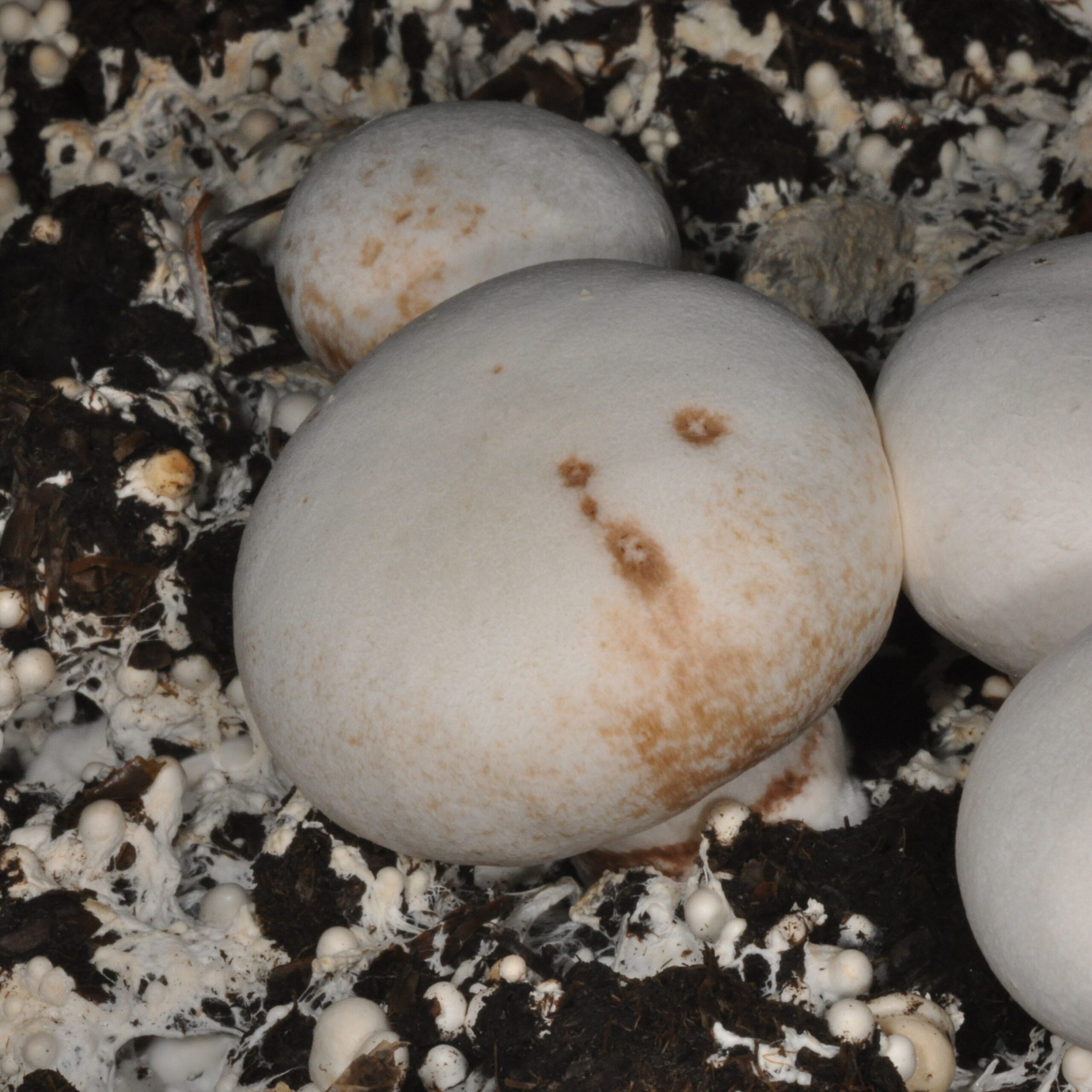
Under favourable conditions, bacteria multiply very quickly, depending on the type of bacteria, in as little as 20 to 60 minutes. So what is the trick to preventing bacterial blotch? Ensure that the conditions are not favourable for bacterial blotch, but are favourable for our “own” mushrooms. How do you do this?
What are the right conditions for bacteria? Warm and humid. These are also the conditions for mycelium to grow. However, I believe there is a big difference. A humid climate does not mean that it is wet. That you see free water. And that is precisely the biggest difference.
When the climate unit requires humidification, steam or fine water mist is added to the air that is blown into the cultivation room via the air duct. This mist, visible as vapour, comes out of the air hose and is particularly visible at the point where the air enters the room.
This visible vapour consists of free water: small water droplets that have not yet been absorbed by the air. A clear sign of this is the wet floor under the air duct, where the air enters the room. With a strong torch, you can often still see water droplets floating in the air (see also page 79 of Mushroom Signals).
These droplets eventually end up on the growing bed, precisely in the places where the mycelium or, later in the cultivation process, the pinheads form. This keeps the surface too wet. This creates ideal conditions for bacteria, allowing them to multiply rapidly and en masse.
If the RH falls below the set minimum setting, the climate computer opens the humidification valve. The following then happens in the climate unit:
After the cooling coil the air is humidified , but cannot absorb this extra moisture. After all, air that is cooled to or below the condensation temperature already has a RH of 100%. Without heating, no extra moisture can be absorbed into the air.
As a result, the added humidification water condenses in the supply air. This is visible as fine water droplets that remain suspended in the air.
Water droplets are heavier than air and therefore fall relatively quickly. This happens mainly immediately after the air is blown into the room, causing free water to settle mainly at the front of the room. This situation leads to localised free water on the surface, which increases the bacterial pressure. This causes bacterial spots to form, particularly in the front part of the room.
Mark den Ouden | Mushroom Blog